Robotic Welding Trends That Are Reshaping Modern Manufacturing Lines
Robotic welding has moved past the stage where it was treated as a premium option for only the largest plants with the deepest capital budgets. On many modern manufacturing lines, it has become a practical answer to a pile of real operational problems: labor shortages, part variability, throughput pressure, traceability requirements, and the simple fact that quality drift gets expensive fast. What has changed is not just the robot itself. The whole surrounding system has matured, from sensing and fixturing to HMI programming, end of arm tooling, offline simulation, and the way welding cells connect with CNC automation and upstream processes.
That broader shift matters. A welding robot that lays down a nice bead in a demo cell is one thing. A welding robot that runs three shifts, tolerates incoming variation, survives spatter, communicates with the plant network, and lets a technician recover from faults without waiting for a controls engineer, that is a different level of manufacturing tool. The trends worth watching are the ones that push robotic welding from isolated equipment toward an adaptable production system.
The move from hard automation to adaptable cells
For years, one of the common complaints about robotic welding was that it only made sense when part volumes were high and designs stayed fixed for long stretches. That view still has some truth in it. If a shop is building ten wildly different assemblies every week, manual welding may remain the sensible choice for at least part of the mix. But many manufacturers do not live at either extreme. They operate in the messy middle, where production volumes are moderate, SKU counts are growing, and engineering changes never seem to stop.
That is where today’s robotic welding cells are gaining ground. More builders are designing systems around quicker changeovers, modular fixtures, and programs that can be adjusted without rewriting everything from scratch. In practical terms, that means weld schedules tied to part families, servo-positioned tooling, and HMIs that let operators select recipes with far less risk of loading the wrong parameters.
I have seen this shift most clearly in fabricators who used to reserve automation for their most predictable parts. Now they are bringing medium-variety work into robot cells because the surrounding infrastructure has improved. Better sensing, smarter clamping, and tighter process control upstream make the robot more forgiving. The result is not unlimited flexibility, but enough flexibility to justify the investment across a wider mix.
Vision and seam tracking are becoming less optional
Anyone who has spent time around welded assemblies knows that parts rarely arrive in the exact condition imagined by a CAD model. Laser-cut components come in with slight edge variation. Bent parts spring differently lot to lot. Tack welds pull geometry around. Even a solid fixture cannot erase all that.
That is why seam finding and seam tracking are becoming a central trend rather than an add-on. In many production environments, they are the difference between a robot that delivers stable output and one that looks great only when everything upstream behaves perfectly. Through-arc tracking, laser seam sensors, tactile search routines, and multi-point part location strategies are all part of the same push: giving the robot reliable feedback before and during the weld.
The practical benefit is obvious, but the trade-offs matter too. Sensors raise cost, add maintenance points, and can be vulnerable to smoke, spatter, reflectivity, and dirty optics. I have watched teams buy vision hardware expecting it to solve poor fit-up, only to discover that no sensor can compensate for chronic upstream inconsistency. The strongest systems use sensing to handle normal process variation, not to mask bad manufacturing discipline.
When implemented well, however, sensing extends the useful operating window of robotic welding dramatically. It reduces crashes, improves first-pass quality, and limits the amount of manual touch-up that quietly eats away at the return on automation.
Welding cells are being designed as part of the full production line
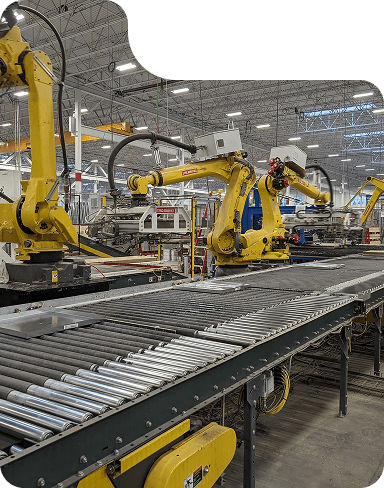
One of the biggest changes in modern plants is that robotic welding is no longer being planned as an island. It is increasingly integrated into broader line architecture, especially where CNC automation, press brake cells, laser cutting, and finishing systems are already digitized. That integration changes both the business case and the engineering approach.
A welded assembly often depends on features produced upstream on CNC equipment. If hole locations drift, edge prep changes, or machining leaves burrs where none were expected, the welding process pays the price. Manufacturers are starting to treat those dependencies more seriously. Instead of asking whether the welding robot can force consistency onto variable parts, they are tightening the entire chain from machining and cutting through staging and inspection.
This is also where machine tending enters the discussion. In mixed manufacturing environments, the same automation team may be responsible for machine tending on CNC cells, pallet handling, and robotic welding integration. That overlap matters because the best automation groups now think in terms of part flow rather than individual machines. A robot loading a machining center and a robot welding a subassembly involve different process physics, but many of the system-level concerns are the same: part presentation, tool access, cycle balancing, fault recovery, operator interface design, and data collection.
When manufacturers connect those pieces, they usually find hidden constraints. The welding robot may not be the bottleneck at all. Sometimes the real problem is fixture loading time. Sometimes it is deburring after machining. Sometimes it is simply that no one built enough in-process buffering to absorb normal line interruptions. The broader trend is toward cells that are engineered with those realities in mind from the beginning.
End of arm tooling is getting more specialized, and more important
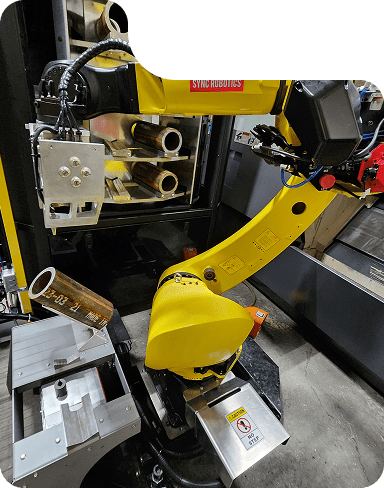
People often focus on the robot brand, payload, or controller generation. Those are important decisions, but on many projects the make-or-break details live much closer to the part. End of arm tooling has become a much bigger part of robotic welding performance, especially where manufacturers are trying to handle multiple part types or combine welding with handling, inspection, or reorientation.
A simple torch mount can still be the right choice for a dedicated, stable application. But more cells now rely on tool changers, wire cutters, anti-spatter stations, reamers, servo grippers, integrated dress packs, and compliance features built around the realities of the weld environment. If the same robot also performs part manipulation between weld passes, gripper design becomes tightly linked to distortion control, access, and repeatability.
This is an area where experience matters because the wrong end of arm tooling decisions can quietly undermine everything else. A gripper that obscures weld access forces awkward robot motion. A tool package that is too bulky limits reach and increases collision risk. A dress pack routed poorly near the wrist will eventually create maintenance headaches, and usually at the worst possible time.
The best robotic welding cells tend to treat tooling as a production asset rather than an accessory. Engineers think about consumable change time, torch cleaning intervals, cable life, smoke exposure, and how easy it is for maintenance to service the system at 2 a.m. After a fault. Those details are rarely glamorous, but they show up clearly in uptime numbers.
Better HMI programming is changing who can keep a cell running
One of the less flashy but more consequential trends in robotic welding is the improvement in HMI programming. A lot of automation still fails in the gap between what engineers expect and what operators can realistically manage under production pressure. If the only person who can recover a common fault is a specialist with a laptop, the cell will never reach its potential.
Modern welding cells are doing a better job of presenting information clearly. Instead of forcing technicians to navigate raw controller menus, better HMIs guide them through recipe selection, fixture confirmation, maintenance prompts, alarm recovery, and quality checks. They also separate protected process settings from routine operational controls, which reduces the chance that someone changes a critical weld parameter just to clear a nuisance issue.
This trend does not mean every interface is excellent. Some still suffer from too many screens, cryptic alarm text, or layouts that make sense only to the programmer who built them. But the best systems recognize a simple truth: the people standing at the cell are not passive users. They are active participants in uptime, quality, and throughput. Good HMI programming respects that and gives them practical control without exposing the process to avoidable risk.
There is also a training benefit. When screens use plain language, clear graphics, and sane workflow logic, onboarding gets faster. In shops with turnover or cross-trained staff, that can matter almost as much as raw cycle time.
More attention is going to weld quality data and traceability
Quality expectations in welded products have become tighter, especially in automotive, heavy equipment, structural components, energy systems, and regulated industries. Robotic welding supports those expectations well, but only when manufacturers capture the right process data and use it intelligently.
Current, voltage, wire https://titusyodf643.lowescouponn.com/how-industrial-automation-solutions-improve-quality-control-in-factories feed speed, travel speed, gas flow confirmation, fault history, and cycle timestamps are increasingly being logged as standard practice. Some plants are pushing further, tying weld programs to part serial numbers, fixture IDs, or traveler records. That does not automatically create quality, but it gives teams something solid to investigate when defects appear.
The smarter trend is not just more data, but better use of it. A mountain of logged values means little if no one knows what normal looks like. Stronger operations define acceptable process windows, monitor drift, and relate welding data back to scrap, rework, and field performance. They also recognize the limits. Electrical data can indicate that something changed, but it cannot replace inspection where critical weld integrity must be verified directly.
The practical win is often faster troubleshooting. If porosity spikes on second shift only, data can help narrow whether the issue is gas delivery, consumables, operator setup, or a change in incoming material. That shortens downtime and reduces the tendency to guess.
Collaborative robots are finding a place, but not everywhere
Cobots attract a lot of attention in welding discussions, usually because they promise simpler deployment and easier programming. They do have a place, particularly in lower-duty applications, prototyping, smaller job shops, and operations that need to automate without committing to a full high-speed industrial cell right away.
Still, it is worth keeping expectations grounded. Welding is a harsh process. Heat, spatter, fumes, and the need for protective guarding often reduce the practical advantages people associate with collaborative systems. In many production settings, a conventional industrial robot remains the stronger choice for speed, payload, reach, and durability. The question should not be whether cobots are fashionable. It should be whether they fit the actual duty cycle, part mix, and safety design of the application.
Where cobot welding works well, it often serves as a bridge technology. A manufacturer with no previous automation experience can start there, build internal confidence, and learn what part standardization and fixturing discipline are really required. Sometimes that path leads to a larger robotic welding program later. Sometimes it reveals that a semi-automated process is enough.
The labor story is shifting from replacement to leverage
There is still a temptation to frame robotic welding as a simple labor replacement tool. That misses how most successful plants actually use it. Skilled welders are still essential. The difference is that their time is being redirected toward work that truly requires judgment, fit-up expertise, repair, qualification work, or high-mix fabrication that does not suit automation.
In several plants I have visited, the real gain came not from reducing headcount but from stabilizing production with the people they already had. They could not hire enough experienced welders to cover all shifts, and quality variation rose when they filled gaps with less experienced labor. Robotic welding gave them a way to lock down repeatable work and free their best people for harder tasks.
That creates a healthier staffing model. Instead of asking one expert to do everything, manufacturers build teams where operators load parts, technicians maintain the cell, programmers optimize paths, and certified welders handle procedures and critical interventions. The shop still needs skill, but it uses that skill more effectively.
A few priorities tend to separate the operations that get value from the ones that struggle:
- They standardize part presentation before blaming the robot.
- They budget for fixtures, sensing, and end of arm tooling, not just the robot arm.
- They invest in operator training and HMI programming early.
- They define maintenance routines for consumables, torch cleaning, and cable management.
- They choose applications with repeatable business value, not just technical appeal.
That list sounds basic, but those basics still determine whether a system runs for years or turns into a high-priced manual workstation with a robot parked beside it.
Offline programming is reducing downtime, but only with good digital habits
Offline programming and simulation are no longer niche tools reserved for large automotive integrators. They are increasingly common across mid-sized manufacturing because they reduce launch risk and allow new programs to be developed without tying up the production robot. That alone can justify the effort in busy plants.
The real benefit appears when simulation is tied to accurate cell models, reliable tooling dimensions, and disciplined revision control. If the virtual cell does not match the real one, confidence disappears quickly. A torch angle that clears perfectly on screen may crash in production because a clamp was modified three months ago and never updated in the model.
When the digital side is maintained properly, though, the gains are substantial. Engineers can test reach, optimize sequence, validate fixture concepts, and estimate cycle times before steel is cut. They can also build safer launches because operators are not trying to debug every program live with production breathing down their necks.
This trend lines up closely with broader digital manufacturing efforts. Shops already comfortable with CNC automation often adapt well to offline robotic workflows because they understand post-processing, revision control, and the cost of undocumented shop-floor changes.
Energy use, fume control, and ergonomics are becoming boardroom issues
Some trends in robotic welding are driven by line-level pain. Others are coming from environmental, safety, and corporate reporting pressures. Welding fumes, heat exposure, and repetitive strain have always mattered on the floor, but many manufacturers are now evaluating these issues with far more scrutiny because they affect hiring, compliance, insurance, and long-term plant planning.
Robotic welding can improve ergonomics significantly by moving operators away from awkward positions, repetitive torch handling, and high-heat zones. It can also support better fume extraction because the process location is controlled and enclosures are easier to engineer around. Energy use is more complicated. Robots consume power, but stable automated processes can reduce rework and improve deposition efficiency, which matters over time.
These factors are not always the headline reason for an automation project, but they increasingly influence approval. Plant leaders are looking beyond immediate labor savings toward total operational resilience.
What manufacturers should watch next
The next phase of robotic welding will probably not be defined by one dramatic breakthrough. It will come from steady improvements in integration, usability, and process awareness. More cells will combine welding with part handling and in-cell verification. More plants will connect welding data with enterprise quality systems. More applications will blend robotic welding with machine tending and CNC automation under the same production planning umbrella.
The manufacturers that benefit most will not necessarily be the ones with the fanciest equipment. They will be the ones that approach automation as a production system, respect the ugly details of fixturing and maintenance, and build cells that operators can actually run. That sounds less exciting than marketing language, but it is what wins on the shop floor.
A reliable robotic welding line is rarely the result of one brilliant decision. It is usually the outcome of dozens of disciplined choices, from part design and gas coverage to end of arm tooling, consumable management, and clear HMI programming. Those are the trends reshaping modern manufacturing lines, not because they are fashionable, but because they make the equipment work under real conditions, shift after shift.
Sync Robotics Inc. — Business Info (NAP)
Name: Sync Robotics Inc.Address: 2-683 Dease Rd, Kelowna, BC V1X 4A4
Phone: +1-250-753-7161
Website: https://www.syncrobotics.ca/
Email: [email protected]
Sales Email: [email protected]
Hours:
Monday: 8:00 AM – 4:30 PM
Tuesday: 8:00 AM – 4:30 PM
Wednesday: 8:00 AM – 4:30 PM
Thursday: 8:00 AM – 4:30 PM
Friday: 8:00 AM – 4:30 PM
Saturday: Closed
Sunday: Closed
Service Area: Kelowna, British Columbia and across Canada
Open-location code (Plus Code): VHWR+PQ Kelowna, British Columbia
Map/listing URL: https://maps.app.goo.gl/xwtV2wEu8ZuKH3se8
Embed iframe:
Socials (canonical https URLs):
LinkedIn: https://www.linkedin.com/company/syncrobotics/
Instagram: https://www.instagram.com/syncrobotics/
Facebook: https://www.facebook.com/syncrobotics/
https://www.syncrobotics.ca/
Sync Robotics Inc. is an industrial robot and controls integration company based in Kelowna, British Columbia.
The company designs and deploys automation solutions for manufacturing operations across Canada.
Services include industrial robotics integration, controls integration, automation system design, deployment support, and related manufacturing automation solutions.
Sync Robotics Inc. is located at 2-683 Dease Rd, Kelowna, BC V1X 4A4.
To contact Sync Robotics Inc., call +1-250-753-7161 or email [email protected].
For sales inquiries, email [email protected].
Hours listed are Monday to Friday 8:00 AM–4:30 PM, with Saturday and Sunday closed.
For directions and listing details, use the map listing: https://maps.app.goo.gl/xwtV2wEu8ZuKH3se8
Popular Questions About Sync Robotics Inc.
What does Sync Robotics Inc. do?Sync Robotics Inc. designs and deploys industrial robot and controls integration solutions for manufacturing operations.
Where is Sync Robotics Inc. located?
Sync Robotics Inc. is located at 2-683 Dease Rd, Kelowna, BC V1X 4A4.
Does Sync Robotics Inc. serve clients outside Kelowna?
Yes—Sync Robotics Inc. is based in Kelowna, British Columbia and serves clients across Canada.
What are Sync Robotics Inc.’s hours?
Monday–Friday: 8:00 AM–4:30 PM; Saturday and Sunday closed.
How can I contact Sync Robotics Inc.?
Phone: +1-250-753-7161
General Email: [email protected]
Sales Email: [email protected]
Website: https://www.syncrobotics.ca/
Map: https://maps.app.goo.gl/xwtV2wEu8ZuKH3se8
LinkedIn: https://www.linkedin.com/company/syncrobotics/
Instagram: https://www.instagram.com/syncrobotics/
Facebook: https://www.facebook.com/syncrobotics/
Landmarks Near Kelowna, BC
1) Kelowna International Airport2) UBC Okanagan
3) Rutland
4) Orchard Park Shopping Centre
5) Mission Creek Regional Park
6) Downtown Kelowna
7) Waterfront Park